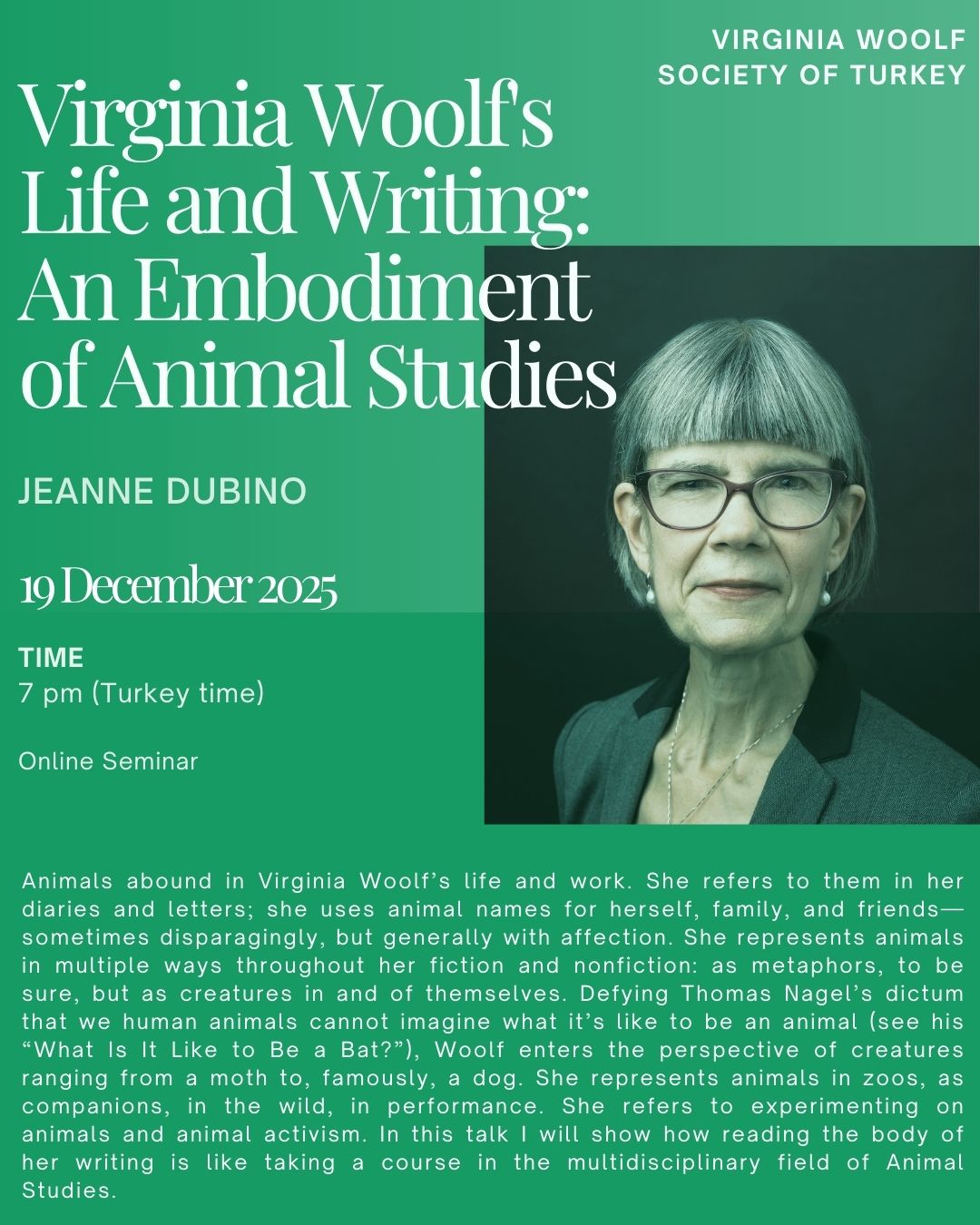
Jeanne Dubino – ‘Virginia Woolf’s Life and Writing: The Embodiment of Animal Studies’
Virginia Woolf’s Life and Writing: The Embodiment of Animal Studies
Jeanne Dubino
Animals abound in Virginia Woolf’s life and work. She refers to them in her diaries and letters; she uses animal names for herself, family, and friends—sometimes disparagingly, but generally with affection. She represents animals in multiple ways throughout her fiction and nonfiction: as metaphors, to be sure, but as creatures in and of themselves. Defying Thomas Nagel’s dictum that we human animals cannot imagine what it’s like to be an animal (see his “What Is It Like to Be a Bat?”), Woolf enters the perspective of creatures ranging from a moth to, famously, a dog. She represents animals in zoos, as companions, in the wild, in performance. She refers to experimenting on animals and animal activism. In this talk I will show how reading the body of her writing is like taking a course in the multidisciplinary field of Animal Studies.
Jeanne Dubino is a professor of English, Global Studies, and Animal Studies at Appalachian State University, North Carolina, USA. She has been a visiting assistant professor of literature and Women’s Studies at Bilkent University, Turkey; a Fulbright Scholar/Researcher at Egerton University, Kenya; Fulbright Specialist at Northeastern University, China, and the Federal University of Paraíba, Brazil; and visiting scholar at Ain Shams University, Egypt. Some of her publications include the edited volume Virginia Woolf and the Literary Marketplace (Palgrave Macmillan, 2010); and the coedited Representing the Modern Animal in Culture (Palgrave Macmillan, 2014), Virginia Woolf: Twenty-First-Century Approaches (Edinburgh University Press, 2014), Politics, Mobility, and Identity in Travel Writing (Routledge, 2015); Virginia Woolf: Critical and Primary Sources (Bloomsbury 2020); The Edinburgh Companion to Virginia Woolf and Contemporary Global Literature (Edinburgh University Press, 2021); Travel and War (Cambridge Scholars Publishing, 2022); and essays, articles, and reviews on Woolf, 20th-21st-century Anglophone literatures, travel and Animal Studies.

 Türkçe
  English